

Beamforming
This is a technology used in network devices, such as routers and Wi-Fi access points , to improve the quality and speed of a wireless connection.
Beamforming allows you to focus on a specific device connected to the network and provide it with a stronger signal, reducing signal loss and eliminating unnecessary noise. This is achieved by adjusting the direction of the radio waves corresponding to the position of the device and providing an individual connection with it.
The principle of beamforming is to concentrate the signal energy in the desired direction by combining signals from different antennas (or microphones) with different phases.
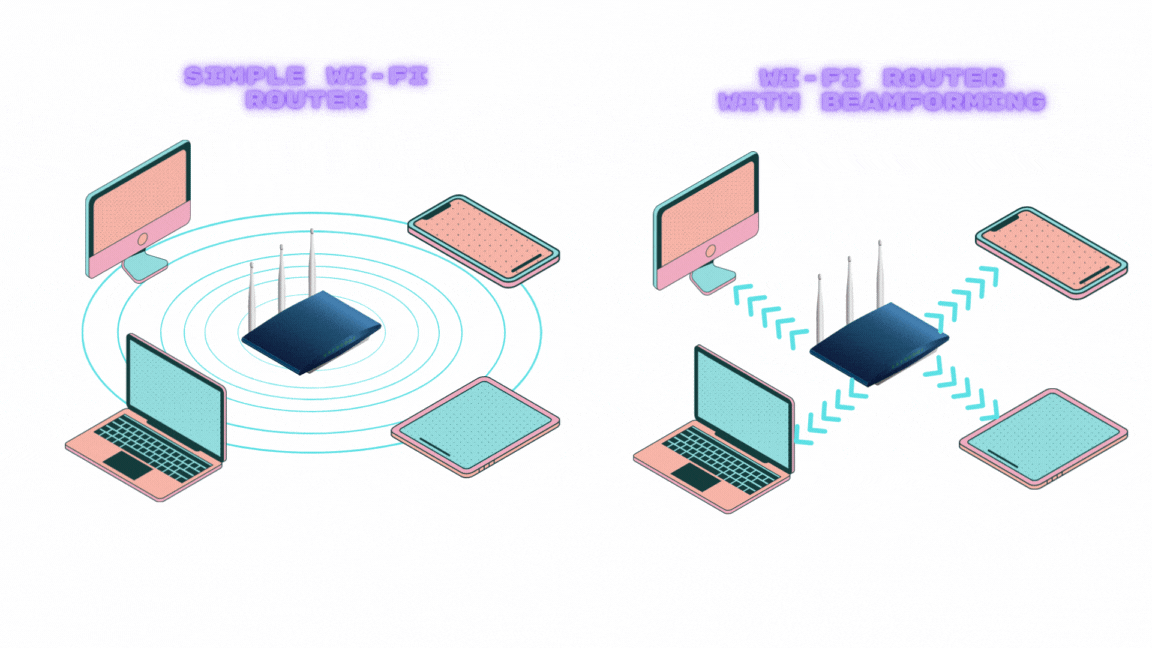
This is achieved by electronic circuits that process the signals from each antenna and provide the optimal phase and amplitude combination of these signals for maximum gain in a given direction.
Beamforming is commonly used in wireless networks, where it allows you to increase data rates and reduce interference from other signal sources. It is also used in speaker systems, such as conference systems and sound reinforcement systems, where it helps improve sound quality and reduce noise.
The advantage of Beamforming is that it allows you to increase data transfer rates, reduce energy consumption and improve indoor Wi-Fi network coverage. It can also help ensure stable network operation in conditions with a large number of connected devices and high radio signal interference.
However, the disadvantage of Beamforming is its limitation – it works only with supported devices that have built-in support for this technology. Also, not all network devices support Beamforming , so it’s important to make sure your router has this feature if you plan to use it.
Some of the advantages of Beamforming technology:
- Increased data transfer speed: Beamforming allows the router to focus signal energy in the direction of a specific device, allowing for increased data transfer speed over distance.
- Increased coverage: Beamforming allows the router to focus the signal in more devices that are in different directions relative to it, which increases the coverage in the wireless network.
- Noise reduction: Beamforming can reduce noise in a wireless network because it focuses the signal in the desired direction and reduces interference with other devices.
- Increased signal strength: Beamforming allows the router to increase signal strength, allowing data to be transmitted over longer distances and in difficult environments, such as large buildings or densely populated areas.
- Improved data transmission quality: Beamforming reduces data transmission errors, increases data transmission speed, and reduces noise, resulting in better data transmission quality.
In general, Beamforming technology allows to provide better performance, reduce the impact of interference on the wireless network and improve the quality of data transmission.
There are some disadvantages of Beamforming technology:
- High cost: Beamforming support can make a router more expensive, so this technology is not used in all routers.
- Compatibility: In order to use beamforming, you need to have support for this technology on both sides – both in the router and in the devices with which it cooperates. If the devices do not support beamforming, it will not work at full capacity.
- Interaction with other devices: Beamforming may affect communication with other devices that are nearby, especially if they do not support beamforming. This may result in reduced communication speed with these devices.
- Limited coverage area: Although beamforming can amplify a signal in a certain direction, it cannot completely replace a signal amplifier or range extender. This technology can provide a better connection in a certain area, but if the devices are outside that area, the connection may be worse.
Which devices have Beamforming?
Beamforming can be supported by various devices with a Wi-Fi connection, such as routers, access points, smartphones, laptops and other devices with a Wi-Fi module.
Usually, support for beamforming is indicated in the technical characteristics of the device, so before buying you need to pay attention to the presence of this possibility. The most modern models of routers support beamforming technology. Also, many new smartphones and laptops from well-known manufacturers.